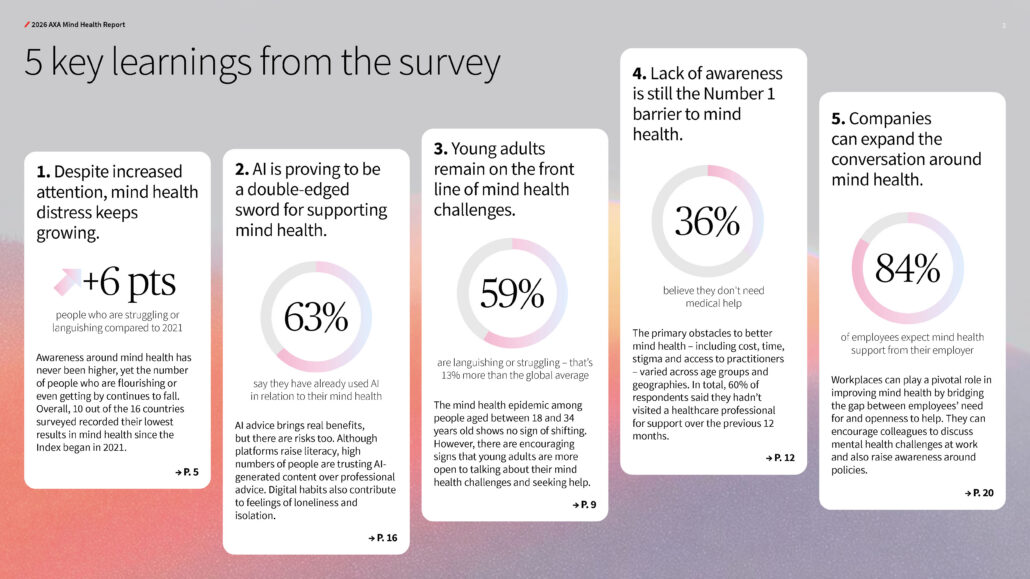
Mental health is no longer solely a public health issue. It is increasingly becoming an economic, social and insurance challenge, affecting workforce resilience, productivity, disability claims and healthcare costs.
The AXA Mind Health Report 2026, conducted across 18 countries including Belgium, highlights a worrying deterioration in mental wellbeing while identifying opportunities for employers, insurers and public institutions to strengthen prevention and early intervention. Beyond measuring mental health trends, the report explores the drivers behind this evolution, from economic uncertainty and digital habits to changing workplace expectations, and provides valuable insights into how organisations can respond.
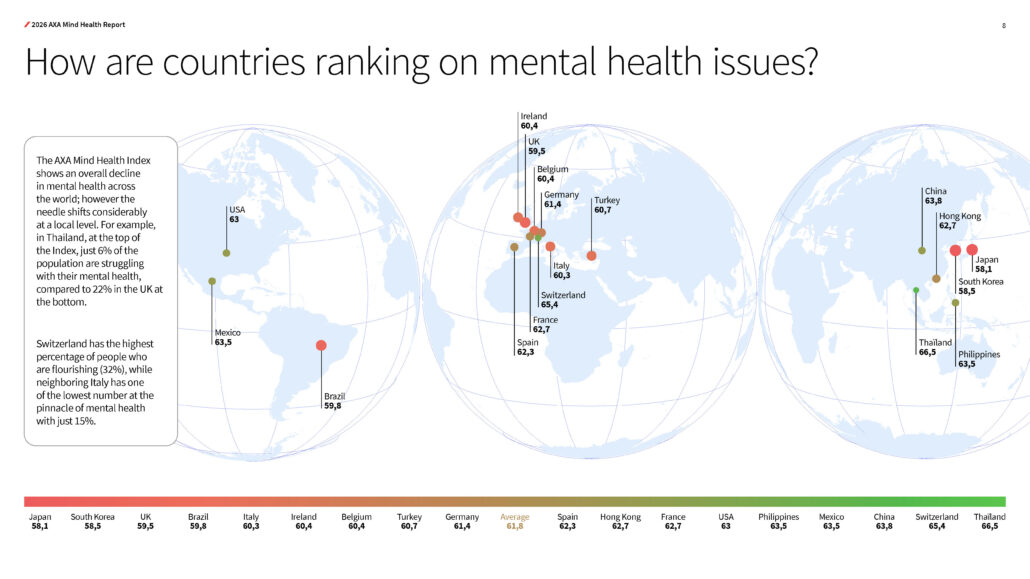
Half of Belgians are now experiencing poor mental wellbeing
For the first time since the study began in 2021, 50% of the Belgian population reports being in a negative mental wellbeing spiral. While the proportion of Belgians reporting a mental health condition has remained relatively stable since 2023 (31%), depression continues to rise significantly, affecting 18% of respondents, an increase of seven percentage points compared with 2021.
The report suggests that this deterioration is driven by a combination of interconnected factors rather than a single cause. Political uncertainty, financial pressure, professional instability and broader societal concerns all contribute to increased anxiety about the future. Digital lifestyles also appear to play an increasingly important role.
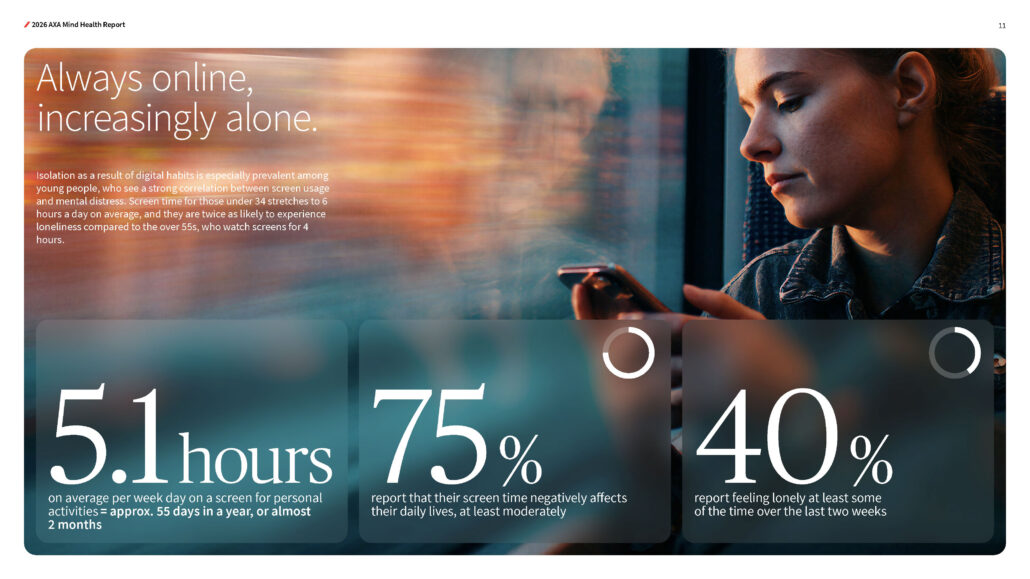
Belgian adults now spend an average of 4 hours and 20 minutes per day in front of screens, rising to 5 hours and 30 minutes among people under 35. Nearly two-thirds of respondents believe excessive screen time negatively affects their mental wellbeing, mainly through poorer sleep quality and increased feelings of social isolation.
Young adults and women remain the most vulnerable populations
As in previous editions, the study reveals important differences across demographic groups.
Young adults between 18 and 34 years old continue to experience the highest levels of psychological distress, with 41% reporting mental health problems. Women also remain disproportionately affected, with 35% declaring mental health difficulties, regardless of age.
These findings highlight that mental wellbeing cannot be addressed through a one-size-fits-all approach. Prevention strategies need to consider the different realities faced by specific population groups, particularly younger generations entering the workforce and balancing increasing professional, financial and social pressures.
Awareness has improved but access to the right support remains a challenge
One encouraging development is that mental health has become a far less taboo subject than it was only a few years ago. However, greater awareness has not necessarily translated into better access to appropriate support.
Almost half of Belgians (48%) did not consult any mental health professional during the past twelve months.
The two main barriers remain unchanged:
- the cost of psychological support (36%);
- the belief that professional help is simply not necessary (35%).
Interestingly, consultation rates vary significantly across age groups. Younger adults are considerably more likely to seek professional support than older generations, reflecting changing attitudes towards mental health.
The report therefore underlines the importance of creating environments where people feel comfortable discussing mental wellbeing before problems become more severe.
Artificial intelligence is emerging as both an opportunity and a risk
One of the most notable additions to this year’s report concerns the growing role of artificial intelligence in supporting mental wellbeing.
More than half of Belgians (54%) have already used AI-based tools for mental health support, while adoption reaches 74% among people under 35. Slightly more than half of users report being satisfied with the advice received.
However, the report also highlights several concerns. Respondents acknowledge that AI may create new forms of dependency (34%), reduce human interactions (33%) and, in some cases, even encourage harmful behaviours (20%).
Rather than replacing professional or personal support, AI should therefore be viewed as a complementary tool that may facilitate self-assessment, information and early guidance while maintaining the essential role of human interaction.
Mental health has become a workplace priority
The workplace remains one of the most important environments influencing mental wellbeing. Among the Belgian employees surveyed, 31% reported having taken sick leave due to mental health reasons during the past twelve months, compared with 26% only two years ago. The figure rises dramatically to 44% among employees aged 18 to 34.
Despite this growing challenge, many employees remain reluctant to discuss mental health openly with their employer. Only 52% say they would be willing to speak to their employer about mental health difficulties. Among those who would not, the most common reasons include considering mental health a private matter, believing the employer cannot provide meaningful support, or fearing negative career consequences.
While only 39% of respondents currently have access to mental wellbeing programmes at work, 80% say they would use such services if they were available. This gap illustrates considerable potential for organisations to strengthen prevention through employee assistance programmes, psychological support, wellbeing initiatives and open communication.
Prevention is becoming as important as treatment
Initiatives such as AXA’s “Mind Health Self-Check“ illustrate this preventive approach. By encouraging individuals to periodically assess their own mental wellbeing through a simple online self-assessment tool, the objective is to promote earlier awareness before mental health deteriorates further.
Such initiatives reflect a broader evolution across healthcare and insurance, where prevention increasingly complements traditional protection mechanisms.
Conclusion
AXA’s 2026 Mind Health Report sends a clear message: mental health is becoming one of the defining risks of our time. For insurers, it affects claims, products, pricing, prevention and customer expectations. For employers, it is a key driver of absenteeism, engagement and productivity. For actuaries, it is an invitation to rethink how mental health risk is measured, modelled and managed.
The challenge is complex, but it also creates an opportunity. By combining data, prevention, employer engagement and responsible technology, insurers can move from passive protection to active resilience.
Mental health should no longer be seen as a peripheral topic in insurance. It is becoming central to the future of actuarial risk management.