
The summer of 2026 has once again put climate risk in the spotlight. Across Belgium and Europe, record temperatures, prolonged droughts, wildfires and unusually low water levels have illustrated how rapidly weather patterns are changing. For insurers, these developments are more than environmental warning signs: they are changing the frequency, severity and geography of the risks they are expected to cover.
At the same time, the first half of 2026 produced relatively moderate insured natural catastrophe losses worldwide. This apparent contradiction highlights one of the insurance industry’s biggest challenges: a relatively benign year does not mean that underlying risk is decreasing. On the contrary, climate change, growing exposure and rising reconstruction costs are progressively reshaping the risk landscape.
A summer of records
Belgium experienced an exceptionally hot and dry summer in 2026. Between June and August, the country went through three heatwaves, while the average temperature between 1 June and 23 August reached 20.3°C, potentially making it the hottest Belgian summer since records began in 1833. On 14 August, temperatures reached 35.7°C in Uccle.
Rainfall figures were equally striking. Belgium recorded only 10.6 mm of rainfall in July, compared with a normal level of 76.9 mm, while rain fell on just three days instead of the usual fourteen. Across Europe, several major rivers reached historically low levels, affecting not only ecosystems but also freight transport, energy production and freshwater availability.
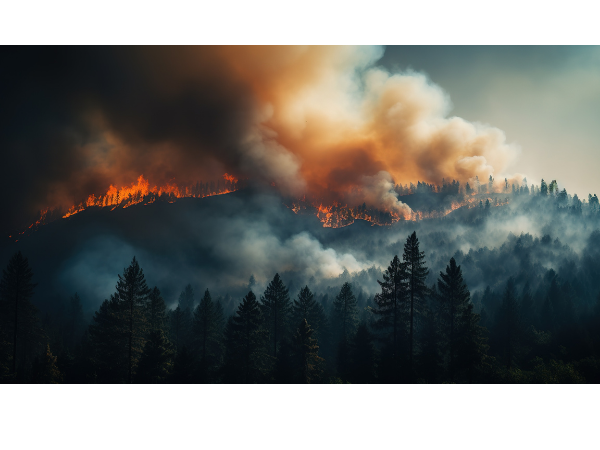
Heat and drought also contributed to another growing hazard: wildfires. More than 600,000 hectares burned across the European Union in 2026, with Portugal, Spain, Italy and Greece particularly affected. Belgium itself was not spared, with more than 3,000 hectares destroyed in the Hautes Fagnes.
The consequences of extreme heat extend beyond property damage. On 27 June, Belgium recorded 654 deaths, 383 above the historical daily average for 1992–2025. Climate risk therefore increasingly cuts across traditional insurance categories, from Property & Casualty to health, life and pensions.
Lower losses do not mean lower risk
Interestingly, this growing climate pressure is not immediately visible in global insured-loss figures.
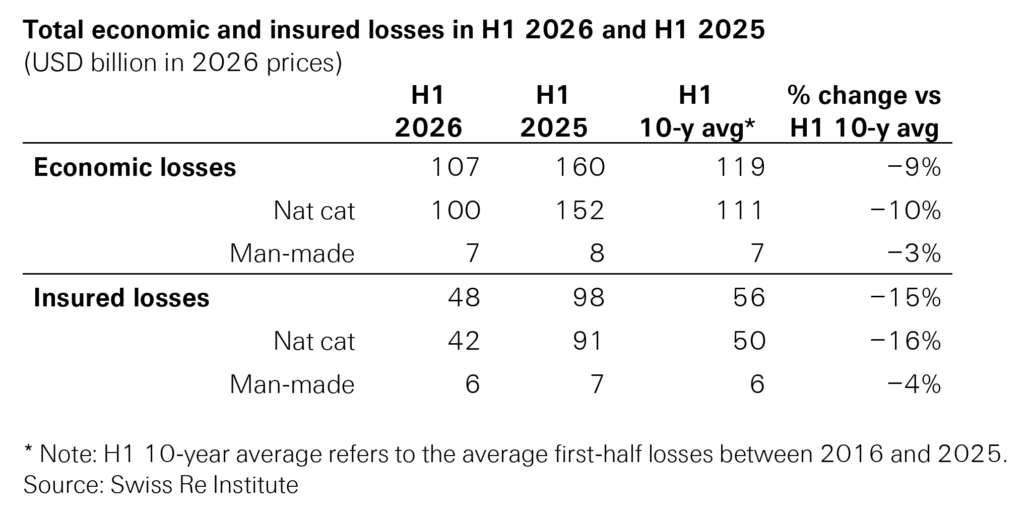
According to Swiss Re Institute, insured losses from natural catastrophes reached an estimated USD 42 billion during the first half of 2026, the lowest first-half total since 2020 and 16% below the ten-year average. Severe convective storms remained the largest contributor, accounting for approximately USD 28 billion.
But these figures require context. Catastrophe losses depend not only on the intensity of an event, but also on where it occurs and what assets are exposed. During H1 2026, several severe storms simply avoided some of the most highly exposed areas in the United States.
The longer-term trend is much more significant. Europe now experiences 64% more days above 30°C than in the 1950s, according to Swiss Re Institute. Wildfires remain a relatively small component of European insured losses, but they are the world’s fastest-growing weather peril. European insured wildfire losses have increased by an estimated 8–11% per year in real terms since 1970.
In other words, insurers cannot interpret a quieter six months as evidence of reduced exposure. One major hurricane, flood, earthquake or wildfire can fundamentally change annual results, while the structural drivers of losses — climate change, concentration of assets in exposed areas and higher reconstruction costs — continue to intensify. Swiss Re therefore points to resilience and risk reduction as increasingly important conditions for maintaining both the availability and affordability of insurance.
From climate risk to insurability risk
This brings the insurance industry to a fundamental question: how do you price a risk that is itself changing?
According to actuarial science professor Katrien Antonio, insurers will increasingly need more sophisticated climate-risk models. Historical claims data alone are no longer sufficient. New approaches combine information on building characteristics and topography with satellite imagery, climate and weather data, while artificial intelligence can help identify relationships across these increasingly complex datasets.
This evolution is likely to affect insurance premiums, but not necessarily through sudden, widespread price increases. Antonio expects the impact to emerge progressively. The more fundamental issue could eventually become insurability itself: can properties located in highly exposed areas continue to obtain sufficient coverage at an affordable price?
Reinsurance will play a decisive role. If reinsurers reduce their appetite for certain locations or hazards, primary insurers may find it increasingly difficult or expensive to maintain coverage. Better modelling can help insurers understand and price those exposures, but modelling alone cannot remove the underlying physical risk.
Climate change could also affect life insurance and pensions. More frequent heatwaves can influence mortality patterns, potentially requiring actuaries to adapt longevity and mortality assumptions over time.
Belgium's €2.3 billion warning
For Belgium, the 2021 floods remain perhaps the clearest illustration of what happens when an extreme event exceeds the assumptions underpinning the insurance system.
The floods resulted in approximately 74,000 claims worth €2.3 billion, making them the costliest natural catastrophe in Belgian history. Five years later, AG Insurance CEO and Assuralia Vice-President Heidi Delobelle warns that the question of how another catastrophe of similar or greater magnitude would be financed has still not been fully resolved.
The insurance industry’s statutory capacity has increased substantially since 2021. According to Delobelle, the legal ceiling has been multiplied by 4.2, bringing insurers’ current capacity for a flood event to around €1.9 billion. Yet this remains below the €2.3 billion cost of the 2021 floods, while studies suggest that future events in both Flanders and Wallonia could generate losses several times larger.
The challenge is to avoid shifting unlimited catastrophe risk onto insurers. Setting their compensation obligations too high could make reinsurance unavailable or prohibitively expensive, ultimately threatening the affordability of coverage for households. Delobelle therefore advocates a clearer public-private framework capable of sharing extreme catastrophe losses while keeping insurance accessible.
And the issue is far from theoretical: storms in Belgium at the end of May and June 2026 alone are expected to cost insurers approximately €450 million
From compensation to prevention
The role of insurance in a changing climate may therefore need to evolve from simply paying for damage to actively helping reduce it.
Prevention is becoming increasingly central to this shift. Insurers can encourage policyholders to protect buildings against floods, fires and other climate hazards, while the principle of build back better can make reconstruction after a claim an opportunity to improve resilience rather than simply restore the previous situation.
But insurers cannot address systemic climate risk alone. Public investment in flood infrastructure, water management and climate-resilient urban planning remains essential. Delobelle points, for example, to creating more space for water through flood expansion areas as a way of significantly reducing future damage.
This increasingly makes climate resilience a shared responsibility between individuals, insurers, reinsurers and public authorities. Better data and actuarial models can improve risk selection and pricing; prevention can reduce expected losses; reinsurance can absorb extreme volatility; and governments can provide the infrastructure and financial backstop required for risks that exceed private-market capacity.
Adapting insurance to a changing climate
The summer of 2026 offers another reminder that climate change is no longer a distant scenario to be incorporated into long-term projections. Its effects are already visible in mortality, property damage, wildfire exposure, water availability and the changing distribution of natural hazards.
For the insurance industry, the challenge will not simply be to calculate higher expected losses. It will be to anticipate how risks are changing while preserving the affordability and availability of insurance.
More sophisticated modelling will undoubtedly be part of the answer. But the growing scale of climate risk also calls for stronger prevention, resilient infrastructure, effective reinsurance and clear public-private mechanisms for exceptional losses.
Ultimately, the question is no longer only how much will climate change cost insurers? It is also how insurance can continue to fulfil its protective role in a world where yesterday’s exceptional events are increasingly becoming tomorrow’s expected risks.
Such initiatives reflect a broader evolution across healthcare and insurance, where prevention increasingly complements traditional protection mechanisms.
Sources:
- L’Echo (29 August 2026), “Climat : l’été de tous les records en 9 chiffres” — Elodie Ombelets.
- Assuropolis (31 August 2026), “Le changement climatique met les assurances sous pression, mais une forte hausse des primes n’est pas encore à l’ordre du jour” — Luc Sanders, based on an interview with Prof. Katrien Antonio.
- Swiss Re Institute (11 August 2026), “Rising heat, growing exposure, changing hazards: benign first half of 2026 masks rising natural catastrophe risk”.
- L’Echo (11 July 2026), “Heidi Delobelle, CEO d’AG Insurance : ‘Cinq ans après les inondations, on ne sait toujours pas qui paiera la prochaine catastrophe naturelle’” — Xander Vlassenbroeck.